

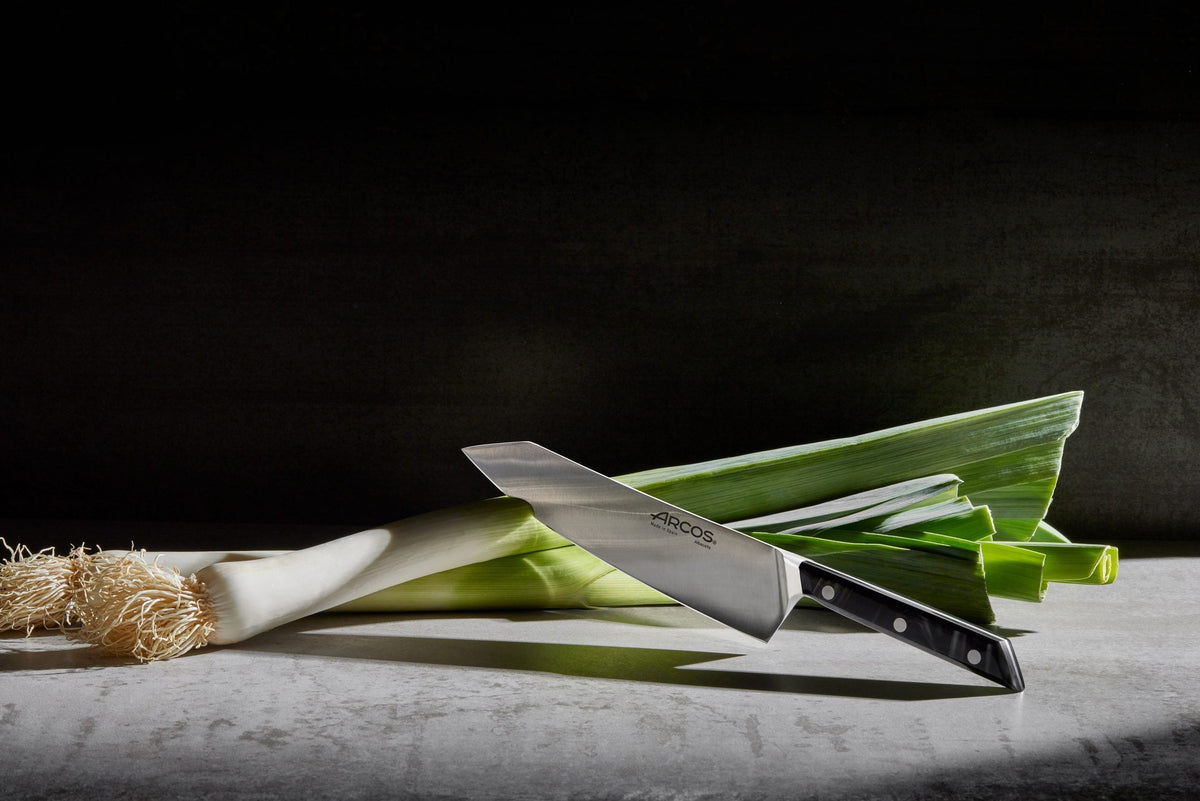
One for meat, another for fish, a special one for cheese, even one just for bread. We completely understand— before you know it, one of your kitchen drawers ends up overflowing with all kinds of knives. But if we’re honest with ourselves, how many of them do we actually use on a regular basis? We all already know the answer.
The truth is, you don’t need twenty different knives to cook well. What really makes a difference is having a carefully chosen core set of knives that can handle 90% of the tasks you actually do in an everyday kitchen. Let’s put together the perfect kitchen knife set without spending a euro more than necessary.
Chef's knife or Santoku, the essential
A chef's knife or Santoku is the main cutting tool in many kitchens. It can slice, chop and prepare vegetables, meat, fruit, fish and herbs.
The difference lies in the blade shape. A chef's knife has a more pronounced curve for a rocking motion, while a Santoku is more compact and precise for straight cuts.
When choosing one of these take into account its length, since it can vary between 18 and 20 cm, as well as other elements such as the ergonomics of the handle, the balanced weight and the ease of maintenance of the edge.

The bread knife, much more important than it may seem
Not every knife cuts bread well. An unsuitable blade can crush or tear the loaf rather than slice it cleanly.
A bread knife stands out thanks to its long, serrated blade, designed to glide through hard crusts without squashing the soft interior. And what many people don’t realize is that it’s useful for far more than just bread. It’s also perfect for slicing ripe tomatoes, cakes, fruits with tough skins, and even delicate foods that need a cleaner, smoother cut.
The serrated edge is the key feature. A blade around 20 cm long is useful for home baking and everyday bread.

The paring knife: a small tool with many uses
You may not find it necessary at first, but it is one of the most useful. You will see!
A paring knife handles precise tasks such as peeling fruit, trimming vegetables, removing seeds and preparing strawberries.
The ideal is a short, light and manageable blade of about 8-10 cm.
Filleting knife: precision for meat and fish
If you regularly prepare meat or fish, a filleting knife is useful. Its long, narrow blade helps make thin slices and precise cuts without tearing the food.
Compared with a chef's knife, a filleting knife emphasises flexibility and smooth slicing. Choose a blade that glides through food without excessive force.

Utility or vegetable knife: an everyday all-rounder
Between a chef's knife and a paring knife in size, a utility knife is useful for medium vegetables, fruit, cold cuts, sandwiches and quick preparation tasks.
How to mount a good basic block of knives
What we told you at the beginning, the key here is not to buy many, but to choose well according to what you need.
For everyday cooking, start with a chef's knife, paring knife and bread knife. If you enjoy more detailed preparation, add a filleting knife and a utility knife for extra precision.
For a small kitchen, a good Santoku, paring knife and compact bread knife cover many tasks without crowding the drawers.

What a difference a good knife from a mediocre one
Beyond looks and design, there are a few key details that truly define the quality of a knife. Our advice is to always choose one with a comfortable, ergonomic handle, a blade that holds its edge well, balanced steel construction, and materials that make sharpening and maintenance easy over time.
This is not going to have many knives, but to have the most suitable ones close to you.
You may also like

Annual Knife and Pan Checklist: How to Know What to Replace in Your Kitchen
One day, your favourite knife starts slipping on vegetables, food sticks to the frying pan and the peeler no longer works well. Should you repair these tools or replace them?...

A Quick Guide to Choosing and Caring for Non-Toxic Ceramic Pans
It is just as important to pay attention to how we cook as it is to know exactly which tools and utensils we use to do it. It is in...

Ceramic Non-Stick Pans: How Coatings Have Evolved and What to Look for Before Buying
Looking back, it is clear how much frying pans have evolved. Choosing one used to be straightforward: you considered the size, the price and a few other factors. Today, new...